
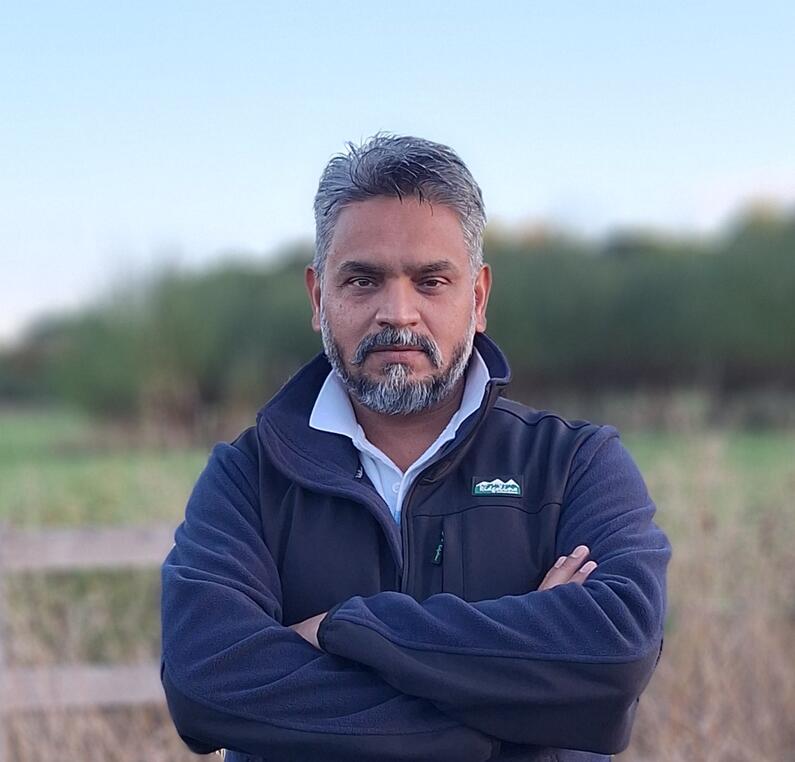
Amir Mohammad
Food and agriculture have shaped both my professional direction and personal purpose. With a Master’s degree in Food Science and Technology from the University of Allahabad, India, I began my career at GlaxoSmithKline, gaining a solid foundation in quality management and operational excellence. My work later expanded to the Middle East, where I managed international meat imports from Brazil, Australia, and New Zealand, developing a deep understanding of animal welfare, certification standards, and global trade dynamics.
Further study in Meat Science at the University of Bristol strengthened my expertise in humane slaughter, sustainability, and supply-chain integrity. Today, alongside my consultancy supporting processors, abattoirs, and certification bodies, I hold full-time responsibility as Continuous Improvement Manager at Corvedale Fresh Ltd (Euro Quality Lambs Group), driving welfare, efficiency, and compliance across operations.
In parallel, I founded a registered charity (Charity Entrust Foundation) in 2023 focused on education and community development. My guiding principle remains constant: combining scientific insight with ethical leadership to build food systems that are humane, resilient, and sustainable.
Killing Sustainability, Straining Welfare: Ecological and Ethical Costs of UK Small Abattoir Decline
CHK Foundation

Study Overview
The proposed research, “Killing Sustainability, Straining Welfare: Ecological and Ethical Costs of UK Small Abattoir Decline,” addresses a critical and under-recognized threat to UK food systems. Over the past decade, small abattoirs have been disappearing at rates approaching 10% per year, undermining both the ethical integrity and environmental resilience of the meat supply chain. This project investigates how that decline negatively impacts animal welfare, rural economies, and sustainable farming practices, and proposes actionable strategies to reverse it.
Through a mixed-methods design, the study will combine qualitative interviews with farmers, abattoir operators, regulators, and policy experts with quantitative spatial mapping of transport distances, emissions, and closure patterns. Case studies of both thriving and failed small abattoirs will help identify conditions for resilience or collapse. The research will also explore policy instruments, such as cooperative ownership, mobile slaughter units, regulatory reform, and financial support mechanisms, to propose a roadmap for revitalization.
The core aim is to reframe small abattoirs as essential rural infrastructure rather than relics of the past. The findings will offer evidence-based recommendations for government, industry, and civil society actors to preserve humane slaughter, reinforce local supply chains, and maintain biodiversity through support for niche and rare breeds. In doing so, it aspires to contribute both to more ethical meat systems and to the resilience of UK rural landscapes.